
Last updated September 10, 2026
Full 25-point door and opener safety check with every visit - springs, cables, rollers, tracks, and your LiftMaster or Chamberlain opener included
You get a price before we start. It does not change when the truck arrives.


 Before
 After
After Before
 After
After Before
 After
AfterGarage Door Repair Maintenance Checklist for Pearland Homeowners
Here’s a number that surprises most Pearland homeowners: in July and August, we get more calls for garage doors that won’t close than for broken springs. The culprit isn’t mechanical failure. It’s a photo-eye sensor that fogged over overnight from Gulf Coast humidity and convinced the opener the door was blocked. A dry rag fixes it in thirty seconds. Ignored for a week, that same fogged sensor forces the motor to work against phantom resistance until the logic board gives out. This guide is built around what actually breaks first in Pearland, Texas, not a generic checklist written for Phoenix or Minneapolis. For more local insights, see our Garage Door Warning Signs: A Pearland Homeowner’s Reference Guide. You’ll learn the monthly five-minute routine that prevents most local service calls, the right lubricants for our heat, and how to spot a spring losing tension before it snaps and leaves your car trapped inside.
Quick Answer
The most effective garage door maintenance routine for Pearland homeowners is a monthly ten-minute check focused on five things: photo-eye lenses, spring and roller lubrication, weatherstripping condition, door balance, and opener force settings. Our humidity and summer heat demand more frequent lubrication and condensation checks than drier climates, and south-facing doors need weatherstripping inspected twice as often as north-facing ones. Most Pearland service calls can be prevented by catching these five issues before they cascade into motor burnout, snapped cables, or a door that won’t seal against hurricane-season rain.
Table of Contents
- Why Pearland’s Climate Breaks Garage Doors Differently
- The Monthly Pearland Maintenance Checklist (10 Minutes)
- The Condensation Check: Photo-Eye Lenses and Logic Boards
- Lubrication for High Heat: What Stays Put and What Melts Off
- Weatherstripping and Bottom Seals: Timed to the Wet Season
- Testing Spring Tension Safely: The Door-Lift Test
- Documenting Your Checklist: What to Write Down and Why It Saves Money
- Common Mistakes to Avoid
- When to Call a Professional
- Frequently Asked Questions
- The Bottom Line
Why Pearland’s Climate Breaks Garage Doors Differently
Pearland sits in a climate band that punishes garage door hardware in ways that national maintenance guides never address. We get three specific conditions that work together: sustained heat above 95°F from June through September, humidity that routinely stays above 80% overnight, and the occasional hard freeze in January or February that catches everyone off guard. Each one attacks a different component of your door.
The heat is the most obvious problem. In August, the air inside an uninsulated Pearland garage routinely hits 110°F and sometimes pushes past 120°F. Cheap spray lubricants like WD-40 evaporate or run off metal surfaces at those temperatures. Springs expand and contract with the daily cycle. Rollers grind against tracks that have shifted minutely from thermal expansion. Doors on west-facing garages take the worst of it, absorbing direct afternoon sun for four or five hours straight.
The humidity does something sneakier. It condenses on cooler surfaces at night, just like it does on your windshield. Photo-eye lenses, opener logic boards, and exposed metal components all collect microscopic water droplets. Over weeks, that moisture causes rust on cheap hardware and electrical confusion on sensors. It’s the single most overlooked factor in Pearland garage door failures, and we’ll cover the specific fix below.
And then there are the freezes. They last a day or two, but when they hit, any hardware already weakened by summer heat and humidity stress becomes brittle. Springs snap. Cables fray and let go. The door that survived August can fail catastrophically in February because the damage accumulated quietly for six months. The maintenance routine below is designed to catch that damage before the freeze finds it first.
The Monthly Pearland Maintenance Checklist (10 Minutes)
You don’t need a professional to handle most of this, and you don’t need special tools beyond a dry rag, a can of the right lubricant, and your eyes. Here’s the complete monthly routine we recommend to every homeowner in Pearland. Run through it on the first Saturday of every month, and you’ll catch the problems that cause 80% of the service calls we make.
- Wipe both photo-eye lenses with a dry microfiber rag. They’re the small round or square sensors mounted about six inches off the floor on either side of the door opening. Even a thin film of condensation or dust can trip them. Do this before anything else.
- Run the door through a full open-close cycle and listen. A healthy door is quiet and smooth. Grinding, squealing, or a rattling sound tells you something is loose, dry, or worn. Note where the noise is coming from.
- Watch the door during the cycle. Does it hesitate? Does one side rise faster than the other? Does it jerk when it starts or stops? All three signals point to balance, roller, or track issues.
- Check the bottom seal. Close the door and look along the bottom edge from inside the garage. If you see daylight through gaps or cracking along the seal’s surface, it needs replacement before the next heavy rain.
- Test the balance. Pull the red emergency release cord and manually lift the door to waist height. Let go. If it stays put, your springs are doing their job. If it drops or rises, the balance is off and needs professional attention. Re-engage the opener afterward.
- Check opener force settings. With the door closed, press the button to open it. When it’s fully open, press the button to close it. If the door reverses on its own without touching anything, the force sensitivity is too high and needs adjusting.
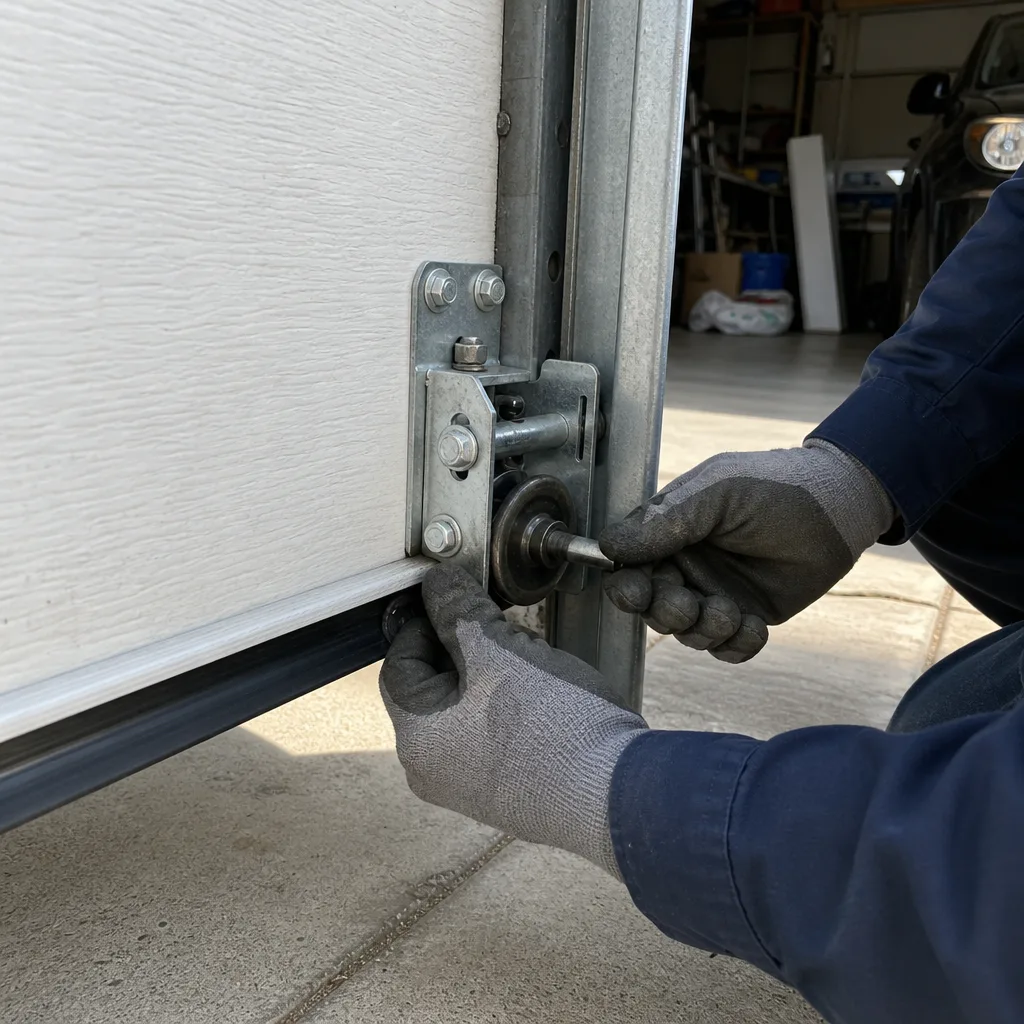
- Inspect visible hardware. Look at hinges, brackets, and bolts. Tighten anything visibly loose with a socket wrench. Don’t touch spring hardware yourself – those are under dangerous tension and belong to a professional.
Ten minutes, once a month, and most Pearland garage door failures simply won’t happen. The sections below go deeper on the items that need more explanation.
The Condensation Check: Photo-Eye Lenses and Logic Boards
This is the Pearland-specific step that no generic checklist includes, and it’s the one that saves the most service calls in our climate. Every night when temperatures drop and humidity rises, condensation forms on the coolest surfaces in your garage. Your photo-eye lenses are prime candidates. So is the logic board inside your opener motor head.
Start with the photo-eyes. These sensors sit on the bottom corners of your door opening, and they’re supposed to communicate with each other to detect obstructions. When moisture fogs the lens, the beam weakens. The sensor reads that as a blocked doorway and refuses to close the door, or it sends inconsistent signals that force the opener to work harder. Wiping both lenses with a dry cloth takes thirty seconds and fixes the immediate problem.
The logic board is more serious. It’s the circuit board inside the opener housing, and when Pearland humidity condenses on it repeatedly, corrosion builds up on the solder points. You can’t easily fix that yourself, but you can prevent it. Keep the opener housing dry. If you store anything in your garage that releases moisture – wet towels, power-washed equipment, a car that drips after rain – move it away from the opener. If you notice any visible rust or white powdery buildup on the opener’s exterior, have a professional inspect the board before it fails mid-cycle with your car trapped inside.
In our experience serving Pearland for two decades, this condensation issue accounts for more summer no-close calls than every other cause combined. A monthly lens wipe is the cheapest insurance you’ll ever buy for your garage door.
Lubrication for High Heat: What Stays Put and What Melts Off
Most garage door maintenance guides say to lubricate your door every six months. We say every three months in Pearland, and the reason is simple: our summer heat destroys lubricant. Products that work fine in Ohio or Michigan break down at 110°F garage temperatures. What you use matters as much as how often.
Skip the WD-40. It’s a solvent and water displacer, not a lubricant, and it evaporates within a week in Pearland summer conditions. Skip white lithium grease too – it hardens in heat and turns gummy. What works in our climate is a silicone-based spray lubricant or a garage-door-specific product designed for metal-to-metal contact. Look for something that says “high temperature” on the label, and apply it sparingly. More is not better. Excess lubricant attracts dust, and dust plus humidity makes a paste that wears out rollers faster than dry metal would.
Here’s exactly what to lubricate and what to leave alone:
- Metal rollers: Apply a small amount to the bearing area where the wheel meets the shaft. Do not lubricate nylon rollers – they’re self-lubricating.
- Hinges: A drop on each pivot point keeps them moving smoothly without grinding.
- Springs: Lubricate the torsion spring above the door or the extension springs along the tracks. This prevents rust and reduces friction. Use a product that penetrates friction and bonds to metal.
- Track: Do NOT lubricate the track itself. It needs friction to keep the rollers rolling rather than sliding. A lubricated track causes drift and jerky movement.
- Chain or belt: A light coating on the drive chain if your opener uses one. Belt-driven openers don’t need it.
The best time to lubricate is late evening when the metal has cooled, so the lubricant penetrates before the next day’s heat hits. If you’re not sure what your door needs, we’re happy to handle it during any Garage Door Repair service call – it’s part of a proper tune-up, and we carry the right products for Pearland conditions.
Weatherstripping and Bottom Seals: Timed to the Wet Season
Weatherstripping is the rubber or vinyl seal that runs along the bottom of your door and sometimes along the sides and top. Its job is to keep water, bugs, and outside air from getting under the door. In Pearland, it works harder than it does almost anywhere else in the country, and it fails faster on some doors than others.
South-facing garage doors take direct sun for most of the day. That UV exposure breaks down rubber and vinyl seals at roughly twice the rate of north-facing doors. If your garage faces south or west in a Pearland neighborhood like Shadow Creek Ranch or Silverlake, check your weatherstripping monthly during summer. Look for cracking, brittleness, or gaps where the seal no longer meets the floor evenly.
Time your replacement planning around hurricane season, not calendar quarters. The right approach is to inspect thoroughly in early June, before the peak of the wet season, and again in early October, after the worst summer heat has done its damage. If you see cracking in June, replace the seal in July, not next February. A failed bottom seal during a heavy Pearland thunderstorm lets water pool under your door, damaging anything stored on the garage floor and creating the exact humid conditions that cause electrical problems in your opener.
Replacing a bottom seal is a homeowner-possible job on most doors. You’ll need the correct replacement seal for your door brand – Clopay, Amarr, and Wayne Dalton doors all use slightly different profiles – and a measuring tape to confirm the width. If the seal is riveted or integrated into the door panel rather than sliding into a channel, leave it to a professional. We stock seals for all major brands and can replace one during a routine service visit without turning it into a separate trip.
Testing Spring Tension Safely: The Door-Lift Test
Your garage door weighs between 150 and 250 pounds, depending on material and insulation. Two springs – either torsion springs above the door or extension springs along the tracks – do the actual lifting. The opener motor just guides the motion. When springs lose tension, the opener works harder and burns out faster. The fix is cheap if you catch it early and expensive if you don’t.
Here’s the safe test that tells you if your springs are doing their job. You won’t need tools, and you won’t need to touch the springs themselves.
- Close the door completely. Make sure it’s latched and not partially open.
- Pull the red emergency release cord hanging from the opener rail. This disconnects the door from the opener motor.
- Manually lift the door by its handle or bottom edge. Use both hands and lift to about waist height, then let go slowly.
- Watch what happens. A properly balanced door stays roughly where you left it. It might drift an inch or two, but it won’t fall.
- If the door drops quickly toward the floor, your springs have lost tension or are on their way out. If the door shoots upward, the springs are over-tensioned. Both are problems.
- Test again at mid-height and at about three-quarters open. Inconsistent behavior at different heights is a sign of uneven spring wear.
- Re-engage the opener by pulling the cord back toward the motor or running the opener until it reconnects.
If the door fails this test, don’t ignore it. Springs that lose tension gradually transfer all the lifting work to your opener motor, and Pearland’s heat is already hard on motors. A spring replacement costs a fraction of what a new opener costs. And never – not once, not ever – try to adjust or replace a spring yourself. The tension in a garage door spring is enough to cause serious injury or death if it lets go. We’ve done spring work since 2004, and even with years of experience, it’s a job that demands respect and the right tools. For help finding qualified help, read our How to Hire a Garage Door Contractor in Pearland: A Step-by-Step Guide.
Documenting Your Checklist: What to Write Down and Why It Saves Money
Here’s the habit that separates Pearland homeowners who never pay for avoidable repairs from those who do. Write down what you observe during your monthly check. It takes ninety seconds, and it gives any garage door professional something no verbal description can match: a timeline.
Get a simple notebook or start a note on your phone. After each monthly check, record three things: the date, any noise you heard during operation, and any changes in how the door feels or behaves. That’s it. If the door hesitated on opening, write “hesitates at start” with the date. If the balance test showed slight drift, write “drifts down from waist height” with the date. If you wiped photo-eye lenses and the problem went away, write that down too.
Here’s why it saves you money. When a Pearland homeowner calls us about a noisy door, the first question is always “how long has it been doing that?” Most people guess. A documented history gives us exact information. We can tell whether a noise started two weeks ago and is getting worse, or has been present for eight months and suddenly changed pitch. That distinction changes the diagnosis. A recent, worsening noise points to a failing roller. A long-standing noise that changed suddenly points to something more serious. With documentation, we fix the right problem the first time. Without it, we sometimes have to investigate, and investigation takes time.
Documentation also protects you on warranty claims. If a newly installed door starts misbehaving, a dated log showing the problem began three months after installation carries more weight than a vague recollection. It’s the same principle as keeping service records for your car. Your garage door goes through more cycles than you think – two to four times a day, every day, in Pearland’s heat. Treat it like the hardworking machine it is.
Common Mistakes to Avoid
- Using WD-40 as a lubricant. It’s a water displacer, not a long-term metal lubricant, and in Pearland’s summer heat it evaporates within days. Use a silicone-based or high-temperature garage door lubricant instead.
- Lubricating the track. The track needs friction to keep rollers rolling. A slippery track leads to jerky movement and premature roller wear.
- Ignoring a slow or hesitant door. When a door hesitates at the start of its cycle, the opener is already working harder than it should. That strain doesn’t fix itself, and every week of operation in summer heat shortens the motor’s life.
- Replacing the opener before checking the springs. If the opener stops lifting a door it used to handle easily, the springs are usually the problem. Replacing the opener without addressing spring tension means the new one fails the same way.
- Testing spring tension by touching the springs. The door-lift test described above requires no contact with spring hardware. Touching, prying, or adjusting springs yourself is genuinely dangerous.
- Failing to re-engage the opener after a manual test. Forgetting to pull the emergency release cord back into place means the next time you press the button, the opener spins without moving the door. That’s a common and confusing false alarm.
- Deferring weatherstripping replacement until winter. By the time a Pearland winter arrives, the seal has already failed through months of wet-season exposure. Replace it in June or July, not February.
When to Call a Professional
Most of this checklist is homeowner territory. Some things are not. Call a professional without hesitation if your door fails the balance test, if you see visible rust or wear on spring hardware, if the opener makes grinding sounds that don’t respond to lubrication, or if the door comes off its track. Those are not DIY situations, and they get worse fast. If your garage door has passed the point of maintenance, Garage Door Repair in Pearland covers the full range of what we’ve handled since 2004. Otto’s Garage Door offers free estimates in Pearland. Call (346) 476-5401, and a live person answers – often Otto himself – and quotes the job on the phone before we ever show up.
Frequently Asked Questions
Monthly for the ten-minute visual and functional check described in this guide, and every three months for lubrication. Pearland’s heat and humidity accelerate wear faster than most climates, so the standard six-month lubrication interval from national guides isn’t frequent enough here. A monthly check takes less time than brewing coffee, and it catches problems before they become service calls. Browse our more guides & resources for additional maintenance tips.
Summer is when Pearland’s humidity condenses on photo-eye lenses and logic boards, causing intermittent no-close behavior. Metal components also expand in the heat, tightening tolerances and amplifying any existing friction or alignment issues. If your door misbehaves only in summer, the problem is usually environmental – condensation or thermal expansion – rather than a failed component. Wiping the lenses is the first step; call us if it persists, and we’ll diagnose it properly.
Yes, for the items in this checklist: wiping photo-eyes, lubricating rollers and hinges, checking weatherstripping, testing balance with the door-lift method, and documenting your observations. No, for anything involving spring hardware, cable tension, or the door coming off its track. Those components store dangerous energy and are responsible for serious injuries every year among people who try to fix them alone.
Rain followed by cool overnight temperatures creates exactly the condensation that fogs photo-eye sensors. The immediate fix is to wipe both lenses with a dry cloth and try again. If it still won’t close, check for debris or standing water in the sensor path, then call a professional if the problem persists. Don’t force the door closed by holding the wall button – that bypasses safety sensors and indicates an unresolved issue.
DIY maintenance costs under $20 for a can of quality lubricant and a rag. Professional tune-ups in Pearland typically run between $75 and $150, depending on what’s included, and price should always be quoted and agreed before any work starts. If maintenance reveals a bigger problem – worn springs, a failing opener – expect repair costs in the $150 to $400 range depending on the component. Call (346) 476-5401 for an exact quote; estimates are free, and the number we quote on the phone is the number you pay.
Yes. We’ve worked on every major brand sold in the Pearland market, including Genie, Clopay, Amarr, and Wayne Dalton, plus LiftMaster, Chamberlain, and Craftsman. Parts for older or discontinued models sometimes require ordering, but diagnosis and most repairs are same-visit. For new installations, Garage Door Installation in Pearland covers your options across brands and materials.
Belt-driven openers with DC motors handle heat and humidity better than chain-driven or AC-motor models because they run cooler and quieter. Look for models with metal gears rather than plastic, since plastic gears soften and strip at sustained 110°F garage temperatures. We carry and recommend several models that have held up well across years of Pearland service calls. See Garage Door Opener in Pearland for current options, or call (346) 476-5401 for a recommendation based on your door’s weight and your garage’s sun exposure.
The Bottom Line
Pearland’s garage doors fail differently than garage doors in drier or cooler climates, and your maintenance routine should match. The monthly ten-minute check – wipe the photo-eyes, run the cycle and listen, check the bottom seal, test the balance, inspect the hardware – prevents most of the service calls we make. Lubricate with a high-temperature silicone product every three months, not every six. Watch your weatherstripping closely in June and October, especially on south-facing doors. Test your spring balance monthly and document everything. Ten minutes a month beats a $300 service call any day, and when you do need professional help, a documented history makes the fix faster and cheaper. Pearland homeowners who follow this routine rarely call us for emergencies. The ones who skip it keep our phone ringing in July. The name on the van is the same name on the invoice, and Otto is a palindrome – reads the same from either end, same as the door. We like it when things come back around. Start here with Otto’s Garage Door home, and when you’re ready, call (346) 476-5401 for a free estimate.
Written by Otto Reinhardt, Owner at Otto’s Garage Door, serving Pearland since 2004.